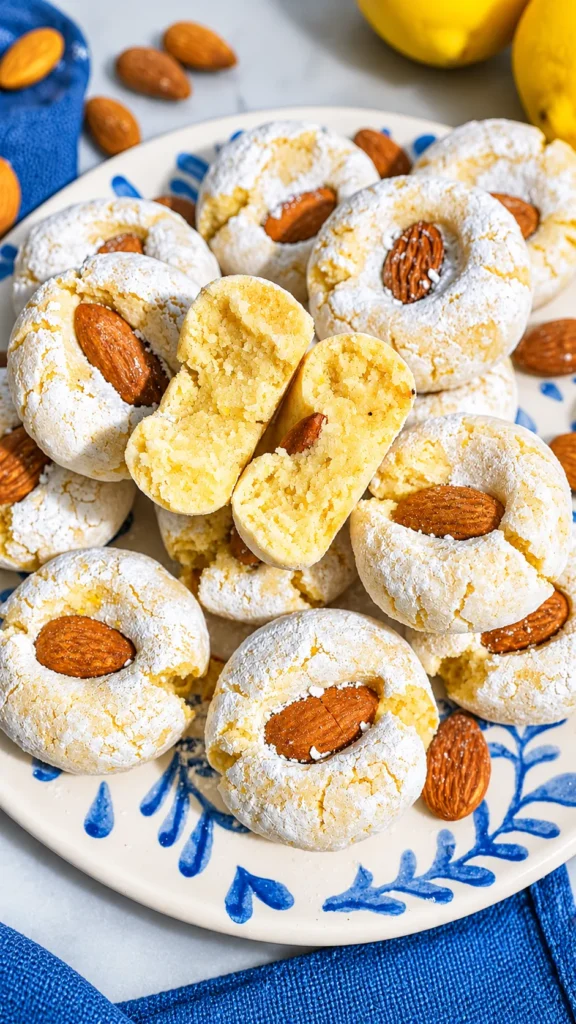
There is something truly irresistible about homemade lemon almond cookies. With their delicate golden centers, lightly cracked powdered sugar coating, and beautiful whole almond decoration, these cookies offer the perfect combination of sweetness, citrus freshness, and rich nutty flavor.
Inspired by traditional Italian almond cookies, this recipe creates wonderfully tender treats with a slightly crisp exterior and a soft, moist interior. Each bite delivers the natural sweetness of almonds followed by the refreshing aroma of fresh lemon zest.
These cookies are especially appealing because of their beautiful rustic appearance. The snowy white coating develops delicate cracks during baking, revealing the golden almond dough underneath. A whole almond pressed into the center gives each cookie an elegant finishing touch.
Whether served with morning coffee, afternoon tea, or as part of a holiday dessert platter, these homemade lemon almond cookies are guaranteed to become a favorite.
They are also naturally gluten-free when made with certified gluten-free ingredients, making them a convenient option for people who avoid wheat flour.
Best of all, the recipe requires only a handful of ingredients and very little preparation time.
Ingredients
For the Lemon Almond Cookies
-
250 g finely ground almonds or almond flour
-
150 g granulated sugar
-
2 large egg whites
-
1 tablespoon freshly grated lemon zest
-
1 tablespoon fresh lemon juice
-
1 teaspoon vanilla extract
-
½ teaspoon almond extract, optional
-
¼ teaspoon salt
-
½ teaspoon baking powder
For the Decoration
-
80 g powdered sugar
-
20–24 whole almonds
-
Extra lemon zest, optional
Why These Lemon Almond Cookies Are So Special
The secret to these cookies lies in their simple ingredients and unique texture.
Unlike traditional butter cookies, which depend on butter and wheat flour, these almond cookies use finely ground almonds as their main ingredient.
Almond flour contains natural oils that help create a soft, rich, and slightly chewy interior.
The egg whites act as a binder, holding the almond mixture together while keeping the dough tender.
Fresh lemon zest provides the strongest citrus aroma because the outer peel contains fragrant natural oils.
A small amount of lemon juice adds brightness and balances the sweetness.
The powdered sugar coating creates the cookies’ signature cracked appearance during baking.
As the cookies expand slightly in the oven, their white surface separates into delicate patterns that make every cookie look unique.
Choosing the Best Almond Flour
For the finest texture, use blanched almond flour made from almonds with their skins removed.
This produces cookies with a pale golden color and a delicate consistency.
Regular ground almonds can also be used, although they may create a slightly darker and more rustic appearance.
Avoid almond meal that is excessively coarse, as it can make the cookies crumbly.
If preparing almond flour at home, grind blanched almonds in short pulses using a food processor.
Be careful not to overprocess them, as the natural oils can turn the mixture into almond butter.
Fresh Lemon Makes a Difference
Fresh lemon is one of the most important ingredients in this recipe.
The zest delivers a bright, fragrant citrus flavor without adding too much liquid to the dough.
When grating the lemon, remove only the yellow outer layer.
The white layer underneath, known as the pith, has a bitter flavor and should be avoided.
For the best results, choose an unwaxed lemon and wash it thoroughly before zesting.
Freshly squeezed lemon juice is preferable to bottled juice because it offers a cleaner, brighter taste.
The Secret to the Perfect Texture
A successful lemon almond cookie should have a delicate contrast between its exterior and interior.
The outside should be lightly firm, while the center remains tender and moist.
The key is avoiding excessive baking.
Almond cookies may appear slightly soft when first removed from the oven, but they continue to firm up as they cool.
Baking them until completely hard can result in a dry texture.
Chilling the dough before shaping also helps prevent excessive spreading and makes the mixture easier to handle.
Part 2: Step-by-Step Preparation
Step 1: Prepare the Ingredients
Begin by measuring all the ingredients carefully.
Place the almond flour, granulated sugar, baking powder, and salt in a large mixing bowl.
Wash and dry the lemon thoroughly.
Using a fine grater, remove approximately one tablespoon of lemon zest.
Cut the lemon in half and squeeze enough juice to measure one tablespoon.
Separate the egg whites from the yolks, ensuring that no yolk enters the whites.
Step 2: Mix the Dry Ingredients
Using a whisk or wooden spoon, combine the almond flour, sugar, baking powder, and salt.
Mix until everything is evenly distributed.
If the almond flour contains large lumps, break them apart with your fingers or sift the mixture.
This helps create a smoother cookie dough.
Step 3: Prepare the Egg White Mixture
In a separate bowl, lightly whisk the egg whites until they become foamy.
They do not need to form stiff peaks.
Add the vanilla extract, almond extract if using, lemon juice, and freshly grated lemon zest.
Stir gently until combined.
The mixture should smell pleasantly citrusy.
Step 4: Make the Almond Cookie Dough
Pour the egg white mixture into the bowl containing the dry ingredients.
Using a spatula, gently fold everything together.
Continue mixing until a thick, slightly sticky dough forms.
The dough should hold together when pressed between your fingers.
If the mixture seems excessively dry, add a teaspoon of egg white at a time.
If it feels too wet, incorporate a small amount of additional almond flour.
Avoid adding unnecessary liquid because the dough must remain firm enough to shape.
Step 5: Chill the Dough
Cover the bowl with plastic wrap or a reusable lid.
Place it in the refrigerator for approximately 30 minutes.
Chilling allows the almond flour to absorb moisture and helps the dough become easier to handle.
It also reduces spreading during baking.
Step 6: Prepare the Baking Tray
Preheat the oven to 170°C (340°F), using conventional top and bottom heat.
Line a large baking tray with parchment paper.
Place the powdered sugar in a shallow bowl.
Arrange the whole almonds nearby so they are ready for decorating.
Step 7: Shape the Cookies
Remove the chilled dough from the refrigerator.
Using a small cookie scoop or tablespoon, divide it into approximately 20–24 equal portions.
Roll each portion gently between your palms to form a smooth ball.
Each cookie should weigh approximately 20–25 grams.
If the dough sticks to your hands, lightly moisten your palms with water.
Avoid making the cookies too large because they may require longer baking and become unevenly cooked.
Step 8: Coat with Powdered Sugar
Roll each dough ball generously in powdered sugar.
Make sure the entire surface is covered.
For a particularly snowy appearance, coat the cookies twice.
Place the coated balls on the prepared baking tray, leaving approximately 3–4 centimeters between them.
The powdered sugar coating will create the attractive cracked surface during baking.
Step 9: Add the Almond Decoration
Place one whole almond in the center of each cookie.
Press it down gently so it becomes securely attached.
The cookies should flatten slightly but retain their rounded shape.
Do not press too firmly, as this may cause the dough to spread excessively.
Step 10: Bake Until Lightly Golden
Transfer the baking tray to the middle rack of the preheated oven.
Bake for approximately 12–15 minutes.
The cookies are ready when their surfaces develop delicate cracks and the edges become lightly golden.
The centers should still feel slightly soft.
Avoid waiting until the entire cookie becomes dark golden brown.
That would indicate excessive baking and could result in a dry interior.
Step 11: Cool the Cookies
Remove the baking tray from the oven.
Allow the cookies to rest on the tray for approximately 10 minutes.
They will be delicate while hot but become firmer as they cool.
Carefully transfer them to a wire rack.
Let them cool completely before serving.
The finished cookies should have a delicate outer crust and a wonderfully tender almond center.
Tips for Perfect Lemon Almond Cookies
Use finely ground almonds. Fine almond flour creates a smoother texture and helps the cookies hold together.
Choose fresh lemons. Fresh zest produces a noticeably brighter citrus aroma.
Do not overmix. Stir only until the ingredients form a cohesive dough.
Chill before baking. Cold dough is easier to shape and spreads less in the oven.
Coat generously with powdered sugar. A thick coating produces the most attractive cracked appearance.
Avoid overbaking. The cookies should remain slightly soft in the center when removed from the oven.
Cool completely. Allowing the cookies to cool helps them develop their final texture.
Delicious Recipe Variations
Orange Almond Cookies
Replace the lemon zest and juice with fresh orange zest and orange juice.
This creates a sweeter citrus flavor that pairs beautifully with almonds.
Coconut Lemon Almond Cookies
Replace 40 grams of almond flour with finely shredded unsweetened coconut.
The coconut adds a delicate tropical flavor and slightly different texture.
Pistachio Almond Cookies
Replace approximately 50 grams of almond flour with finely ground unsalted pistachios.
The cookies will develop a subtle green color and a delicious nutty flavor.
Chocolate-Dipped Almond Cookies
After the cookies have cooled completely, dip one side into melted dark chocolate.
Place them on parchment paper until the chocolate sets.
The combination of dark chocolate, almonds, and lemon creates a sophisticated dessert.
How to Store Lemon Almond Cookies
These cookies can be prepared in advance, making them ideal for holidays, celebrations, and homemade gifts.
Once completely cooled, place them in an airtight container.
Store at room temperature in a cool, dry place for approximately 4–5 days.
For longer storage, freeze the baked cookies in a freezer-safe container for up to three months.
Separate layers with parchment paper to prevent sticking.
Thaw at room temperature before serving.
If necessary, dust with a little fresh powdered sugar to restore their decorative appearance.
Frequently Asked Questions
Can I make these cookies without wheat flour?
Yes. This recipe uses almond flour instead of wheat flour. For strict gluten-free diets, verify that all packaged ingredients are certified gluten-free.
Why are my almond cookies too dry?
The most common causes are excessive baking or using too much almond flour.
Remove the cookies while their centers are still slightly soft.
Can I use bottled lemon juice?
Yes, but freshly squeezed lemon juice usually provides a brighter flavor.
Fresh lemon zest is especially important for the characteristic aroma.
Do I need to whip the egg whites?
No. Lightly whisking them until foamy is sufficient.
Whipping them into stiff peaks can change the texture of the dough.
Can I prepare the dough ahead of time?
Yes. The dough can be covered and refrigerated for up to 24 hours before shaping and baking.
Why didn’t my cookies develop cracks?
The dough may have been too wet, the powdered sugar coating too thin, or the oven temperature too low.
Proper chilling and generous coating help produce the desired appearance.
Serving Suggestions
Lemon almond cookies are delicious served with freshly brewed coffee, espresso, black tea, or herbal tea.
Their bright citrus flavor also makes them a wonderful accompaniment to vanilla ice cream or fresh berries.
For special occasions, arrange them on a decorative serving platter alongside other homemade cookies.
They also make lovely edible gifts when packaged in small decorative boxes or airtight jars.
Final Thoughts
These soft lemon almond cookies combine simple ingredients with a wonderfully elegant appearance.
Their delicate powdered sugar coating, lightly cracked surface, fragrant lemon flavor, and tender almond interior make them a delightful treat for almost any occasion.
Whether you are preparing cookies for a family gathering, an afternoon coffee break, or a festive dessert table, this easy recipe delivers beautiful results without complicated techniques.
With fresh lemon zest, quality almond flour, and careful baking, you can create delicious homemade cookies that taste just as inviting as they look.